Why Staying in a Yurt Is More Immersive Than Staying in a Camping Pod
If the whole point of camping is to feel closer to nature, then not all glamping accommodation delivers that in the same way.
Camping pods, cabins and shepherd’s huts can be comfortable, convenient and appealing in their own right. But if you are looking for an experience that genuinely helps you slow down, switch off and feel more connected to the outdoors, a yurt offers something quite different.
A yurt does not just give you a place to sleep. It changes the way you experience light, sound, space and the passing of the day. That is what makes it feel more immersive.
A yurt keeps you more connected to natural light
One of the biggest differences between staying in a yurt and staying in a pod or cabin is your relationship with light.
In a camping pod, cabin or shepherd’s hut, the solid walls create much the same separation from daylight as a conventional building. Once the door is shut and the lights go on, the rhythm of the day becomes easy to ignore. That may be convenient, but it is not especially different from being indoors at home.
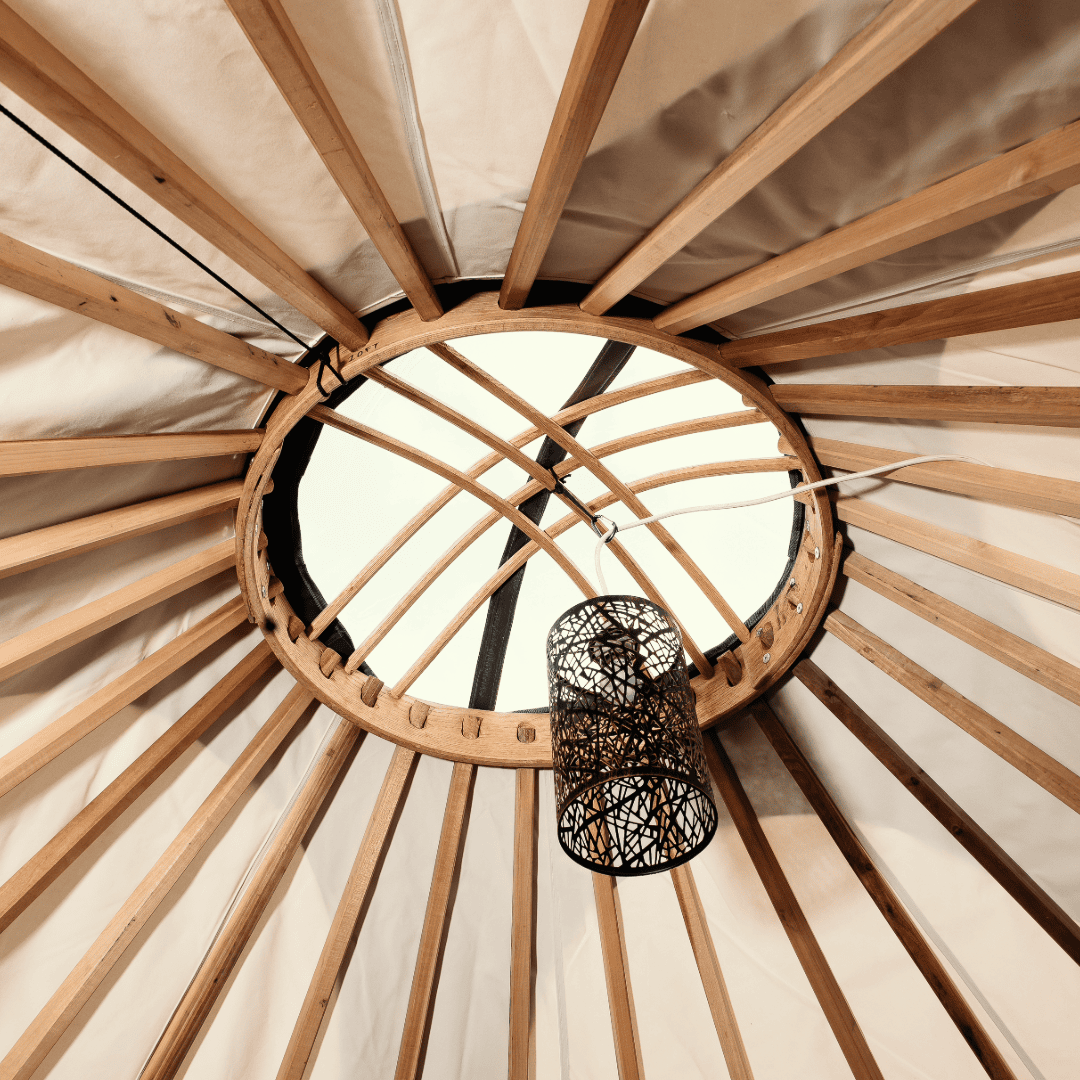
A yurt feels different because the canvas allows daylight to permeate the space more gently. You remain more aware of changing weather, shifting daylight and the fact that morning and evening are actually happening outside. Research on circadian rhythms consistently shows that exposure to natural light, especially in the morning, helps regulate sleep timing, while artificial evening light can delay the body clock. Studies have also found that spending time in natural light-dark cycles while camping can shift sleep timing earlier and better align circadian rhythms.
That is part of why sleeping under canvas can feel so restorative. You are not sealed away from the day in quite the same way.
It feels less like accommodation and more like being outdoors
A pod or cabin may be located in nature, but often it still feels like an indoor room that happens to be placed outside.
A yurt sits somewhere in between shelter and exposure, and that balance is what makes it special. You feel protected from the elements, but not disconnected from them. You are still aware of the breeze, the change in temperature, the rain on the roof, the brightness of the morning and the hush of evening. That creates a stronger sense of actually being in the landscape, rather than simply looking at it from inside a box.
This is also why many people describe a yurt stay as helping them slow down. It is harder to remain in a fully artificial routine when the space itself keeps reminding you what time of day it is and what the weather is doing.
Natural sounds are part of the experience
One of the simplest but most important differences is sound.
In a pod, cabin or shepherd’s hut, thicker solid walls reduce much of the outdoor soundscape. In a yurt, the canvas allows more of the natural world to filter through. You hear the rain more clearly, the wind moving through the trees, birdsong in the morning, and the subtle shifts in the environment around you.
That is not just romantic language. Research suggests that natural soundscapes can support stress recovery and perceived restoration, with studies finding that nature sounds are associated with relaxation and can aid recovery after stress.
That means the sounds you hear in a yurt are not just atmospheric. They are part of what makes the stay feel calmer and more grounded.
A circular space feels different from an ordinary room
There is also something about the shape of a yurt that changes the experience.
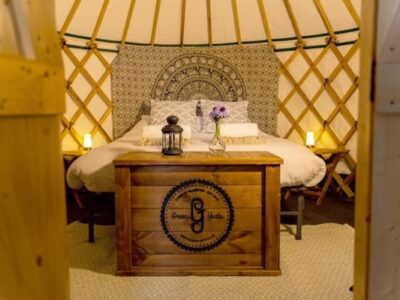
Most of us spend our lives in square or rectangular rooms. A yurt’s circular interior feels softer, more enveloping and, for many people, more calming. Recent research comparing curved and rectangular spaces found that curved rooms were associated with more positive mood and greater calm, while related work has linked rounded forms in architecture with comfort and creativity.
That helps explain why a yurt often feels restful in a way that is hard to put into words. The space itself encourages a different mood.
Instead of corners and hard lines, you have a continuous, flowing shape. It feels less rigid, less domestic, and more like a retreat.
The materials feel closer to nature
Another reason yurts feel more immersive is the quality of the materials.
Canvas, timber and natural textures tend to create a very different atmosphere from the manufactured finishes often found in pods and cabins. Even when a pod is attractive and well-designed, it can still feel like a compact modern room. A yurt, by contrast, usually feels more tactile, softer and more rooted in the outdoor setting.
That fits with broader research around biophilic design, which suggests that spaces incorporating natural elements and materials can support relaxation and reduce stress.
In other words, the experience is not just about what you can see outside the window. It is also about what the space itself is made from and how that makes you feel.
A yurt encourages simpler living
Part of the charm of staying in a yurt is that it naturally invites you into a simpler routine.
There is usually less temptation to replicate everyday indoor habits. The space tends to encourage reading, talking, cooking slowly, listening to the weather, watching daylight change and going to bed when you actually feel the day ending. A pod or cabin can still offer a break, of course, but they often make it easier to carry indoor habits directly into the countryside.
That is why a yurt often feels more like an experience and less like just another type of accommodation.
It is a more memorable version of comfort
The case for a pod is usually convenience. It is solid, familiar and easy to understand. For some people, that will be exactly what they want.
But for anyone looking for something more atmospheric, more sensory and more connected to the outdoors, a yurt offers a better balance between comfort and immersion. It provides shelter without cutting you off from the setting you came for in the first place.
That is really the difference.
A pod gives you comfort in nature.
A yurt gives you comfort with nature.
Final thought
If your idea of a good glamping stay is simply warmth, shelter and a bed, then a camping pod, cabin or shepherd’s hut may do the job perfectly well.
But if you want to feel the landscape more fully — to wake with softer natural light, hear the world outside, notice the weather, and settle into a slower rhythm — a yurt is hard to beat.
It does not insulate you from nature to the same extent.
That is exactly why it feels more immersive.